· 12 minAOG TechnicsTraceabilityRecordsAirworthinessDocument fraud

AOG Technics: the court prices fake aircraft records

60,234 parts sold with forged certificates, £39.3 million in documented losses, $29.2 million for an airline that was not even a customer: what the Zamora sentencing remarks measure

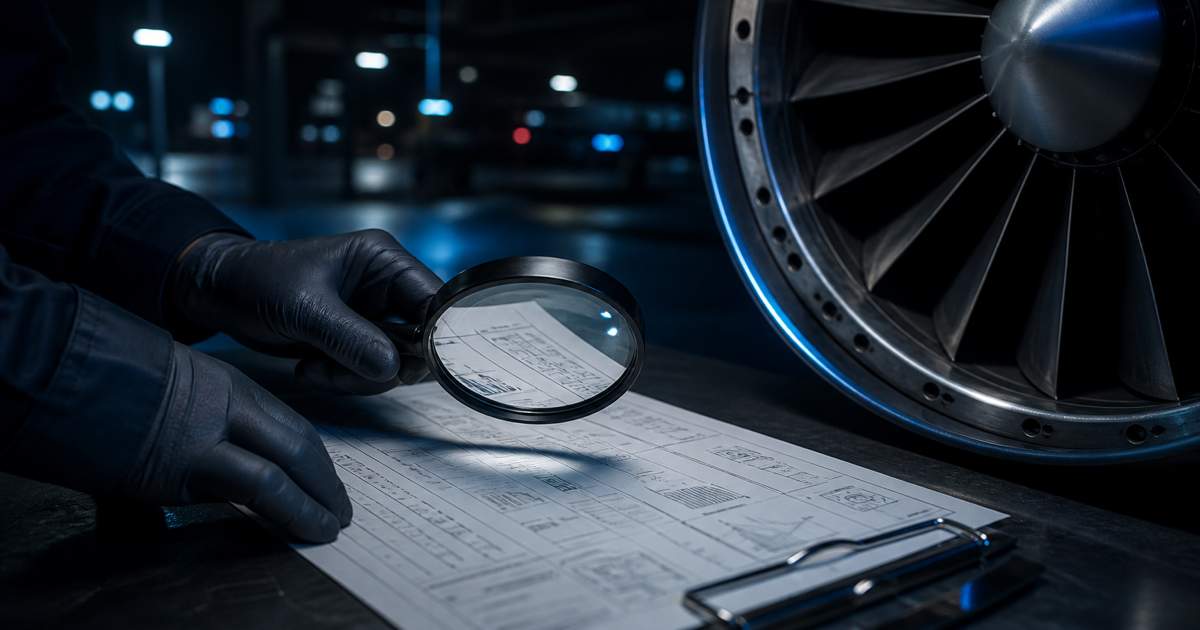
Airliner engine under inspection in a hangar, technical documentation lit in the foreground

On 23 February 2026, the Crown Court at Southwark sentenced Jose Alejandro Zamora Yrala, founder and sole director of AOG Technics, to four years and eight months in prison, together with an eight-year ban on directing a company. Beyond the sentence, Mr Justice Picken's sentencing remarks put a figure, line by line, on what a falsified traceability chain costs the industry: for a CAMO, an operator or an owner, this is a public, quantified judicial measurement of the economic value of records.

This article starts from the amounts in the judgment, not from the history of the scandal. Every figure cited is drawn from the sentencing remarks published by judiciary.uk (R v Jose Zamora, 23 February 2026), unless stated otherwise.

What the judgment prices, line by line

The mechanism, in two lines. AOG Technics was a UK broker of parts for the CFM56, the engine powering Boeing 737 and Airbus A320 aircraft. Between January 2019 and July 2023, the company issued 276 invoices totalling approximately £7.72 million to 67 customers, covering 65,014 parts. Jose Zamora pleaded guilty on 1 December 2025 to fraudulent trading under section 993(1) of the Companies Act 2006.

The documented scale. Of the 276 invoices, 211 related to parts accompanied by forged ARCs and, on many occasions, forged trace documentation. AOG sold 60,234 parts with false ARCs for approximately £6.9 million to 50 customers: 90% of the period's revenue relied on forged documents. Investigators found 197 false ARCs on Zamora's devices, 93 forged Memos of Shipment purporting to show direct purchases from Safran, and at least 41 part certification forms. Some of the forgeries were built on around 140 genuine ARCs supplied by a TAP logistics technician and then altered. Customers, meanwhile, dealt with a "Michael Klein", a "Johnny Rico" or a "David Stevens": fictitious employees, while AOG had only four real people on its payroll.

The losses: £39.3 million, a floor. The Serious Fraud Office put the losses at £39.3 million, based on information from only some of the affected airlines and companies. That figure covers just £4.38 million of AOG's sales, 47,407 parts and 158 invoices, and excludes future business lost by companies supplied with falsely documented parts. The judge concludes that further losses are "likely".

The sentence, as the judgment sets it. High culpability, category 1 harm, a range of five to eight years: the judge takes a notional sentence of seven years, reduced by one third for the guilty plea, giving four years and eight months, half in custody and the rest on licence. On top sits an eight-year director disqualification under the Company Directors Disqualification Act 1986. Yet French press headlines read "five years in prison" (Les Echos, 24 February 2026): the judgment says four years and eight months, and the judgment is authoritative.

AOG Technics: the ruling in figures60,234parts sold with forged ARCsfor ≈ £6.9M, 90% of AOG revenue£39.3Mlosses documented by the SFOa floor: partial data only$29.2MAmerican Airlines' costsnever a direct AOG customer4 yrs 8 moin prison (not "five years")+ 8-year directorship banSource: sentencing remarks, R v Zamora, 23 Feb 2026

The key figures from the Zamora sentencing remarks.

$29.2M for a non-customer: the American Airlines lesson

The largest documented loss is that of American Airlines, the world's largest airline. Yet American Airlines never bought a single part directly from AOG: it sourced parts from suppliers that had themselves bought from AOG, and it relied on the falsified records provided to those intermediaries. The judgment says so explicitly: the airline "relied on the falsified records" without ever being in a contractual relationship with the fraudster.

After the issue came to light, the airline inspected its fleet, identified 28 engines affected by unapproved parts and immediately grounded the potentially affected aircraft until the parts could be replaced. Its costs, itemised at paragraph 55 of the remarks, amount to $29.2 million.

American Airlines: the $29.2M in detailLeasing 23 replacement engines$15.9MLabour and materials$11.8MEngine removal (off-wing)$1.0MLost profits (groundings)$0.4MEngine shipping$0.1MTotal: $29.2M28 engines affected, aircraft grounded

The breakdown of American Airlines' costs as restated by the judgment.

The lesson for any operator is there: your exposure does not depend solely on the quality of your own purchasing. A forged certificate can enter your records through your supplier's supplier, without the name AOG ever appearing in your books. Due diligence on your direct suppliers is necessary but insufficient; a verifiable cut-off point is verifying the certificate with the organisation that issued it.

TAP: EUR 6,580,518.01. A direct AOG customer from April 2022, TAP received 34,372 parts accompanied by forged Safran/GE ARCs, installed into 52 engines, including those of client airlines of its engine shop, among them easyJet. In July 2023, two UK-registered aircraft were grounded and the parts removed and replaced. The breakdown restated by the judgment: EUR 2,560,083.42 for replacement parts, logistics and materials; EUR 229,510.59 for labour; EUR 203,323 for on-wing replacements; EUR 587,601 for substituting aircraft during servicing; and EUR 3 million for profitable work turned away while rectification was underway, at the peak of the summer season.

The other quantified victims. GE ($3.8 million), Safran (EUR 0.67 million), Ethiopian Airlines ($5.73 million), Aero Norway ($2.45 million), GT Engine Services (£0.298 million), Aero Engine Solutions ($0.28 million), then Sentinel, Kellstrom, Fusion and Catavia for smaller amounts. Add unquantified harm: reputational damage (TAP, Fusion, GE) and loss of established customers (Aero Engine Solutions, Sentinel), highlighted by the prosecution.

What the judge says about the value of documents

The judgment devotes paragraphs 6 to 12 to explaining the parts certification system, and that reminder is worth reading for any practitioner. The Authorised Release Certificate (EASA Form 1, FAA 8130-3 or equivalent) serves two functions: declaring the part's airworthiness and ensuring its traceability, through a unique form tracking number and retained copies. Without a suitable ARC, a part cannot be approved for return to service.

On the economic value of documents, the judge is unambiguous. Paragraph 17: "in the absence of genuine documentation, it is not possible to verify the origin of parts sold by AOG", and parts without OEM-issued ARCs are "more difficult to sell and of less value". Paragraph 59: purchasers "were entitled to proceed on the basis that the parts had already been verified by an approved inspector and that the ARCs supplied with them were not forgeries". And at paragraph 84, the strongest characterisation: Zamora's conduct amounted to "a more or less complete undermining of a regulatory framework designed to safeguard the millions of people who fly every day of the year".

In other words, the harm does not lie in the physical condition of the parts, which no one can establish any more, but in the destruction of proof. This is exactly the logic we described for the pre-owned market: the value of a part, like that of an aircraft, rests on its capacity for documentary proof. The Zamora judgment gives it a calibration in pounds, dollars and euros.

What this changes for a CAMO or an owner

The judgment reproduces in full the notice published on 4 August 2023 by EASA, alongside a CAA Safety Notice, which sets the protocol for any suspect part. Owners, operators, maintenance organisations and distributors are asked to "inspect their records to determine whether aircraft or engine parts have been obtained from AOG Technics, either directly or indirectly", to contact "the approved organisation identified on the ARC (e.g. FAA 8130-3 or EASA Form 1) to verify the origin of the certificate", to quarantine any part whose certificate is not attested and to replace any already-installed part carrying a falsified ARC.

For a CAMO or a continuing airworthiness department, this protocol translates into five concrete practices.

  1. Verify the ARC with its issuer for high-stakes parts, especially engine parts and life-limited parts bought through brokers: that is the check that broke the case open, when TAP submitted to CFMI/Safran an ARC whose signatory was not an employee.
  2. Run real supplier due diligence: the organisation's actual existence and substance, headcount, approvals, consistency of signatories. The AOG fraud rested on fictitious employees and a self-awarded "Quality Director"; a call to the certifying organisation or an approvals check could have detected the anomaly.
  3. Trace the chain of custody, back-to-birth where the risk requires it: the EASA notice targets parts obtained "directly or indirectly", which assumes you know each part's chain of custody beyond your immediate supplier. Full back-to-birth traceability applies where the part category or the risk level requires it, starting with engine parts and life-limited parts.
  4. Keep proof of the verifications themselves, in a tamper-evident, timestamped register: in a dispute or an expert assessment, your protection is the ability to prove your controls, as we detailed in our article on the airworthiness review report.
  5. Move fast once doubt arises: between TAP's alert to CFMI (21 June 2023) and the notification to the CAA (13 July 2023), three weeks elapsed; immediate quarantine and escalation to the OEM limited the exposure.

What this article cannot establish

Several limits must be explicit before turning this reading into a decision.

  • £39.3 million is a floor, not a total. The SFO figure relies on some victims only and excludes future lost business; it nonetheless covers more than half of AOG's total sales value (£4.38M of £7.72M) and nearly three quarters of the parts sold (47,407 of 65,014). Use it as a lower bound, never as a central estimate.
  • Double counting is possible on some line items. The defence raised it for American Airlines' costs, where grounding, engine leasing and lost profits may overlap. The judge holds that losses "comfortably" exceed the £500,000 threshold on any approach, but the fine breakdown remains debatable.
  • No part was proven dangerous, and the opposite is not provable. The defence claimed all parts were airworthy; the judge answers that without genuine documentation, no one can know. This article therefore says nothing about flight safety, and that is precisely the problem.
  • The quantified victims are in commercial air transport. The CFM56 powers airline fleets, not business jets. The documentary mechanism is nevertheless identical in business aviation: same Form 1s and 8130-3s, same broker market, same trust in the certificate. The amounts would differ; the lesson is the same.
  • The exact sentence is read in the judgment, not in headlines. This week's French coverage says "five years in prison"; the sentencing remarks set four years and eight months. On quantified subjects, the primary source is the only reliable reflex.

Kepler's take: the records are the asset, and the court just priced them

Kepler's take: our conviction as practitioners is that records are not an administrative cost but the economic life insurance of the asset, and the Zamora judgment has just given that a price: £39.3 million in documented losses, including $29.2 million for an airline that never even chose its supplier's supplier. What destroyed that value was not a mechanical failure; it was the impossibility of verifying a document. Verifying every certificate with its issuer, knowing every part's chain of custody, tracing it back to birth where the risk requires it, and keeping proof of those checks in a tamper-evident register is no longer comfort compliance: it is balance-sheet protection. Kepler Aviation builds traceability and documentation-automation tooling for maintenance and continuing airworthiness management, within the Kepler Digitals ecosystem. To assess how robust your records are against this type of risk, contact us.

Sources

Frequently asked questions

What sentence did the founder of AOG Technics receive?

On 23 February 2026, the Crown Court at Southwark sentenced Jose Zamora to four years and eight months in prison, half of it in custody, plus an eight-year disqualification from acting as a company director. The judge started from a notional seven-year sentence, reduced by one third for his guilty plea. Contrary to some headlines, the sentence is not five years.

How many suspect parts did AOG Technics sell?

According to the sentencing remarks, AOG sold 60,234 engine parts accompanied by forged ARC certificates for approximately £6.9 million to 50 customers, representing 90% of its revenue over the period. In total, 65,014 parts were invoiced to 67 customers between January 2019 and July 2023.

How much did the AOG Technics fraud cost the industry?

The Serious Fraud Office documented £39.3 million in losses, based on only some of the victim airlines and companies and excluding future lost business. As the sentencing remarks themselves note, that figure is a floor.

Why did American Airlines lose $29.2 million without being an AOG customer?

American Airlines never bought directly from AOG: it received parts through suppliers that had sourced them from AOG, relying on the falsified records. After identifying 28 affected engines and grounding aircraft, the airline put its costs at $29.2 million, including $15.9 million to lease 23 replacement engines.

What should you do if a part in your records came from AOG Technics?

The protocol in the EASA notice of 4 August 2023, quoted in the judgment, comes down to three steps: inspect your records for any part obtained directly or indirectly from AOG, have the approved organisation named on the ARC verify the certificate's origin, and quarantine or replace the part if the certificate cannot be attested.

Did the parts sold by AOG Technics endanger passengers?

No safety issue has been established on the supplied parts. But the judge stresses that the opposite cannot be proven either: without genuine documentation, no one can confirm the parts met certification requirements. That very impossibility of verification is the core of the harm.

PB

Pierre Beunardeau

Founder of Kepler Aviation

A project, a regulatory question?

Kepler Aviation supports aviation stakeholders on AI, blockchain and document compliance. Let's talk about your needs.

Contact us