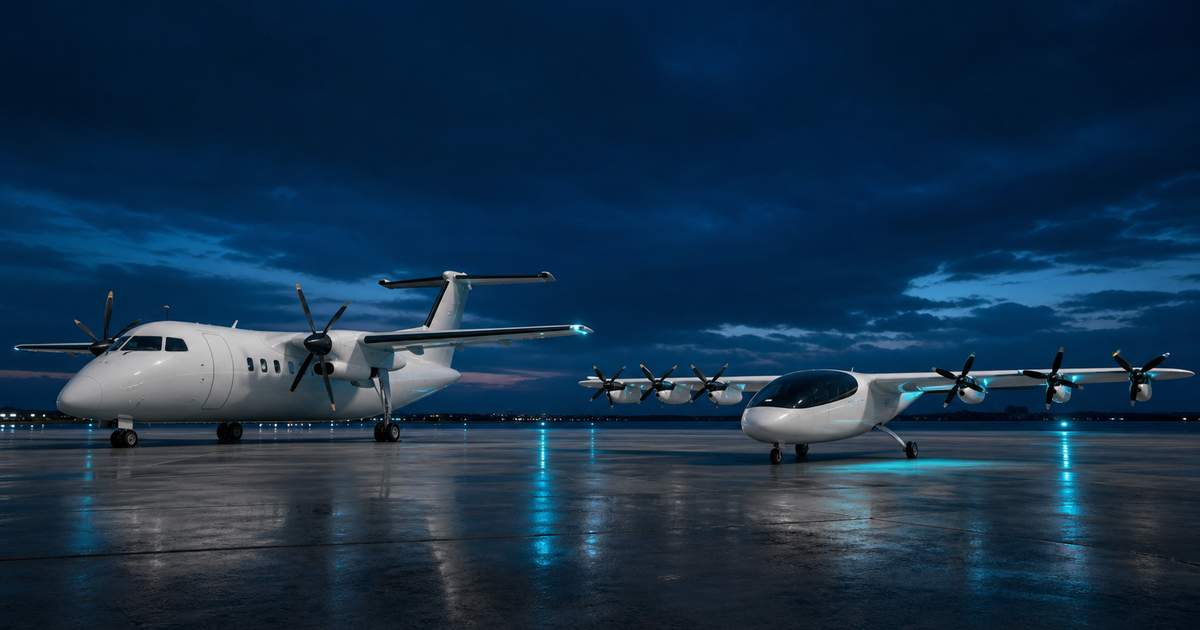
Mixed fleets in 2030: airworthiness in two regimes
Turboprops and batteries will coexist in European regional aviation — what a CAMO should prepare in the records before the fleet goes mixed

Running the airworthiness records of a mixed fleet means keeping two documentary regimes alive in parallel. On one side, classic hours and cycles; on the other, battery state of health and BMS data. This article is a practitioner's anticipation: no battery state-of-health-specific requirement is defined yet, even as classic hours, cycles and records remain governed by the rules in force. It details what a CAMO or operator can prepare before its fleet goes mixed.
The past week delivered two concrete signals of this shift. The first comes from Finland, where a US manufacturer and the City of Helsinki are studying ultra-short electric routes. The second comes from a European short-haul analysis widely covered by the French press this summer. The previous article covered the demonstrator stage: what certifying an electric aircraft actually means. This one moves down to fleet level.
The fact: electric propulsion leaves the demonstrator and enters fleet plans
On 27 August 2026, Electra signed a memorandum of understanding with the City of Helsinki and Haaga-Helia University. The goal: study regional air links between Helsinki and Tallinn with the EL9, a nine-seat hybrid-electric able, according to the manufacturer, to take off and land in 50 metres. The two cities are 80 km apart and exchange 7.5 million travellers a year, today by ferry or through conventional airports. The feasibility study is due to close at the end of 2026. A flight demonstration with the EL2 demonstrator is being considered, with no firm schedule.
FLYING magazine covered the announcement on 28 August, recalling the July partnership with operator Signature Aviation to explore and then deploy such "access points" in the United States. The FAA awarded the EL9 its certification basis in July 2026. The signal is clear: the debate is no longer "will electric aircraft fly", but "where will they land".
On the European side, the NGO Transport & Environment published a short-haul analysis in early August. It cites an EASA analysis: a quarter of European flights cover less than 500 km, a distance within reach of electric aircraft in development. Hybrids could cover up to 1,000 km. The NGO expects commercial launches in 2030. These figures, carried by BFMTV on 6 August and by Voyages d'Affaires the next day, cannot be checked against the original publication to date. The limits section comes back to this.
Why the 2030 fleet will be mixed, not electric
None of these programs will replace a regional fleet in one go. They arrive in small series, on niches, with manufacturer-set dates.
France's Aura Aero is developing the ERA, a 19-seat hybrid-electric. Announced architecture: eight Safran ENGINeUS electric motors and two SAF-compatible turbogenerators. A 900-nautical-mile range, 800-metre runways. The manufacturer targets market entry before 2030, with first prototype testing in late 2026 and a first flight in 2027. According to BFMTV, Aura Aero claims around 700 pre-orders and a first firm order from French airline Pan Européenne Air Service.
Germany's Vaeridion is developing the Microliner, a nine-seat electric announced for 400 to 550 km of range, with certification targeted in 2030 and about a hundred purchase commitments. The Netherlands' Elysian Aircraft, partnered with KLM, targets a 90-seat electric for 2035. America's Electra already holds its FAA certification basis for the EL9. And Heart Aerospace's ES-30, a 30-seat hybrid, still announces 2031 — we detailed that program in the article on the X1 first flight.
Facing them, today's turboprop fleets have twenty to thirty years of life ahead. ATR, Dash 8 and King Air aircraft delivered today will fly well beyond 2035. The result is mechanical: for ten to fifteen years, the same operator will fly conventional-energy aircraft and battery aircraft side by side. Two technologies, two maintenance logics, two families of records. The diagram below places the verifiable milestones.
Only the 2026 milestone is on record; everything else is a target announced by manufacturers.
An airworthiness dossier in two regimes
Here is the core of the matter, and it is a practitioner's anticipation: nothing in current regulation describes these records yet. Regulation (EU) No 1321/2014, the backbone of continuing airworthiness in Europe, has no dedicated section for propulsion batteries. What follows extrapolates existing mechanics toward new objects.
The classic regime is well known: hours and cycles, life-limited parts tracked back-to-birth, AD/SB status, work orders. The maintenance program approved under point M.A.302 paces all of this in flight hours, cycles and calendar intervals. CAMOs have run this regime for decades.
The battery regime would be of a different nature. A propulsion battery does not wear in cycles alone: it degrades with actual use. Operating temperatures, discharge depths, fast-charge frequency, thermal events. Two packs of the same age and cycle count can show very different states of health. The records to keep would therefore be serialized at pack level, not just aircraft level. For each pack: current state of health, charge cycles, charging history, incidents, BMS software versions.
The airworthiness review would have to aggregate both. A hybrid's ARC could not be issued on the classic regime alone. Review staff would check the usual records, then the battery regime's. The review report required by point M.A.903(h), reshaped by Regulation (EU) 2026/100, would record both families of findings. One certificate, two regimes of evidence.
Two evidence flows, one certificate: the documentary architecture to prepare.
Two maintenance programs that do not age the same way
The divergence does not stop at records. It runs through the entire steering of maintenance.
A classic program is steered by flight hours and cycles, with slow, well-documented degradation. Deadlines are predictable months ahead. A program integrating batteries would add state-of-health thresholds: replace a pack when its residual capacity drops below the limit set by the manufacturer's instructions. Yet that degradation depends on the operating profile. An aircraft assigned to short, fast-turnaround routes will not age like one assigned to longer sectors. A mixed fleet's maintenance program would therefore track identical aircraft on diverging trajectories.
Add software. BMS updates would become certified-configuration items, to be traced like a service bulletin. And qualifications: maintenance staff would need high-voltage ratings, which training takes years to spread. For a mixed-fleet operator, the CAMO workload does not double. It changes in nature.
Two residual-value logics
Third divergence: resale value. We documented on the pre-owned market how record completeness sets the price gap between two identical airframes. Electric propulsion would inject that mechanism into a new, costly component: the battery pack.
A practitioner's anticipation again: a hybrid put up for sale in 2035 would see its appraisal bear on two dossiers. The classic one — airframe, engines, AD/SB. And the battery one — state of health, charging history, replacements performed. A pack without complete traceability would weigh on price the way a life-limited part without back-to-birth weighs today. Two aircraft of the same type and age could thus show very different residual values, on the sole quality of their battery records. Lessors, who already finance these programs, will write that requirement into contracts long before regulation does.
What a CAMO or operator can prepare as early as 2026
None of this requires an electric aircraft in the fleet. Everything can be prepared with existing mechanisms.
- Map future certification bases. For each candidate type, identify the baseline and the special conditions, including EASA's SC E-19 for electric and hybrid propulsion.
- Require the battery data plan during negotiation. The contract must state who produces state-of-health data, in which format and with which access rights. After delivery, it is too late to negotiate.
- Prepare the record-keeping system. The CAMO tool must host pack-level serialized tracking: state of health, cycles, charging, incidents, software versions. Configuring it under delivery pressure is the worst scenario.
- Launch high-voltage qualifications. Maintenance staff ratings are built over years, not over a quarter.
- Contract BMS data access. As with engine data today, ownership and access are negotiated with the manufacturer and the lessor.
- Prefigure the two-regime review. Define now how review staff will verify both families of records, and how the M.A.903(h) report will record them.
- Track the texts in the pipeline. The SC E-19 means of compliance still open will set authorities' expectations. Their publication will shape the instructions for continued airworthiness.
A bounded case: the first review of a hybrid in a turboprop fleet
Take a European regional operator — call it Operator N — flying eight turboprops and taking delivery in 2031 of two new 19-seat hybrids. A practitioner's anticipation, grounded in current mechanics.
Before delivery. The CAMO has obtained the manufacturer's instructions for continued airworthiness. The contract guarantees access to BMS data. The record-keeping system tracks each pack by serial number, the way it tracks engine disks. The M.A.302 program covers high-voltage items from entry into service.
During operations. The two hybrids rotate on 300 km routes with fast turnarounds. The turboprops keep the longer sectors. After one year, the packs' states of health already diverge between the two hybrids. One has accumulated more fast charges. The records show it, provided the BMS data flows actually reach the CAMO.
At the first airworthiness review. The turboprops are handled as always. For the hybrids, review staff check both regimes: AD/SB status and work orders on one side, state of health, charging history and BMS versions on the other. The M.A.903(h) report records both families of findings. One ARC per aircraft, but a different preparation.
The case's moral: the difficulty is not technical, it is organizational. It is solved before delivery, not at review time.
Limits: what the sources establish, and what they do not say
- The Transport & Environment figures are second-hand. The analysis citing EASA reached us via BFMTV and Voyages d'Affaires; the original publication could not be located at writing time. We therefore report them as NGO figures carried by the press, not as agency data.
- The Helsinki agreement is a memorandum of intent, not an operation. It launches a feasibility study closing at the end of 2026. No commercial route exists, no operating timeline is announced.
- The EL9, ERA, Microliner and ES-30 are not certified. Their service-entry dates are manufacturer targets. Programs of this kind historically slip.
- No battery-specific aging record-keeping obligation exists yet. M.A.305 of Regulation (EU) No 1321/2014 already imposes generic technical records — installed components, maintenance performed, applicable limitations — but no text today mandates battery state-of-health tracking. The two documentary regimes described here are an anticipation grounded in the logic of special conditions and ongoing programs, not a transcription of written requirements.
- A resale market for hybrid aircraft does not exist yet. The discount mechanism on untracked batteries is extrapolated from the classic life-limited-parts market, not observed.
Kepler's take: mixing is managed in the records before it is managed on the ramp
Kepler's take: our practitioner conviction is that the mixed fleet will not first be a maintenance problem. It will first be a records problem. The operator able to produce, for a single ARC, both classic evidence and battery evidence will keep aircraft leaseable, insurable and sellable. The one treating the battery as an accessory will discover at the first audit, or the first sale, that half its dossier is missing. Preparing the record-keeping system costs a few months of configuration. Rebuilding three years of charging history will cost far more.
Kepler Aviation builds traceability and document-automation tools for maintenance and airworthiness management, within the Kepler Digitals ecosystem. To prepare your records for electric propulsion, contact us.
Sources
- Electra, City of Helsinki, and Haaga-Helia University sign MOU to explore Direct Aviation across the Gulf of Finland, Electra press release, 27 August 2026 — primary source.
- Finland to Study Hybrid-Electric 'Ultra Short' Aircraft, FLYING magazine, 28 August 2026 — press coverage of the Electra release.
- Electra achieves FAA certification milestone for EL9 Ultra Short aircraft, Electra press release, 10 July 2026 — G-1 certification basis, not a type certificate, primary source.
- Un vol européen sur quatre parcourt moins de 500 kilomètres, BFMTV, 6 August 2026 — coverage of the Transport & Environment analysis citing EASA; original publication not located at writing time.
- Transport & Environment: campaigning for electric flights, Voyages d'Affaires, 7 August 2026 — second coverage of the same analysis.
- ERA, the 19-seat hybrid-electric regional aircraft, Aura Aero product page — characteristics announced by the manufacturer.
- Special Condition SC E-19 — Electric/Hybrid Propulsion System, EASA.
- Regulation (EU) No 1321/2014, EUR-Lex — continuing airworthiness (Part-M, Part-CAMO).
Frequently asked questions
What is a mixed electric/hybrid fleet?
A fleet operating conventional aircraft (turboprops, jets) alongside electric or hybrid-electric aircraft in parallel. It is the most likely scenario for European regional aviation toward 2030: new types arrive in small series, without replacing existing fleets overnight.
Will electric aircraft replace regional turboprops?
Not by 2030. According to an EASA analysis cited by Transport & Environment, a quarter of European flights cover less than 500 km, within reach of electric aircraft in development. But the announced programs (Aura Aero ERA, Vaeridion, Heart ES-30, Electra EL9) target gradual entries into service: both generations will coexist for years.
Is recording battery state of health a legal requirement?
No. No continuing-airworthiness rule currently details the tracking of propulsion battery state of health. Everything this article proposes on the topic is a practitioner's anticipation: the type certificate's instructions for continued airworthiness will set the format, and they are not written yet.
Which electric or hybrid aircraft could enter service in Europe around 2030?
The most advanced programs are Aura Aero's ERA (19-seat hybrid, market entry targeted before 2030), Vaeridion's Microliner (9-seat electric, certification targeted in 2030), Electra's EL9 (9-seat hybrid) and Heart Aerospace's ES-30 (30-seat hybrid, 2031 target). All these dates are manufacturer targets, not regulatory milestones.
How will the battery affect an aircraft's resale value?
This is a practitioner's anticipation, not an established market fact: a costly battery pack with a complete state-of-health and charging history will reassure buyers and lessors. A pack without traceability will behave like a life-limited part without back-to-birth records: discount, escrow holdback, or a blocked transaction.
What should a CAMO do now to prepare for a mixed fleet?
Seven workstreams: map future certification bases, require the battery data plan in purchase contracts, prepare battery fields in the record-keeping system, launch high-voltage qualifications, contract BMS data access, design airworthiness reviews able to aggregate both regimes, and track the texts in the pipeline such as the SC E-19 means of compliance.
A project, a regulatory question?
Kepler Aviation supports aviation stakeholders on AI, blockchain and document compliance. Let's talk about your needs.
Contact us